Table Of Content
There is a solution to the problem of order effects, however, that can be used in many situations. It is counterbalancing, which means testing different participants in different orders. For example, some participants would be tested in the attractive defendant condition followed by the unattractive defendant condition, and others would be tested in the unattractive condition followed by the attractive condition. With three conditions, there would be six different orders (ABC, ACB, BAC, BCA, CAB, and CBA), so some participants would be tested in each of the six orders.
Frequently asked questions about within-subjects designs
You typically would use a within-subjects design when you want to investigate a causal or correlational relationship between variables with a relatively small sample. Participants may become exhausted, bored, or less motivated after taking part in multiple treatments or tests. This type of experimental design can be advantageous in some cases, but there are some potential drawbacks to consider. Afterward, the results of the memory tests would be compared to see how the type of exercise influenced memory. So one group of participants would receive one treatment, while another group would receive a different treatment. Between-subjects and within-subjects designs can be used in place of each other or in conjunction with each other.
Risk taking for potential losses but not gains increases with time of day Scientific Reports - Nature.com
Risk taking for potential losses but not gains increases with time of day Scientific Reports.
Posted: Tue, 04 Apr 2023 07:00:00 GMT [source]
Two Ways to Plan Your Study
Within-subjects are typically used for longitudinal studies or observational studies conducted over an extended period. In a 2x2 design, they would examine two types of therapy (cognitive-behavioral and psychodynamic) and two levels of each treatment (short- and long-term). Between-subjects studies tend to have shorter sessions than within-subject ones. An education researcher might want to study the effect of a new program on children and test them before, and after, the new method has been applied. You would administer the same test to all participants and compare test scores between the groups.
Between-Subjects Experiments
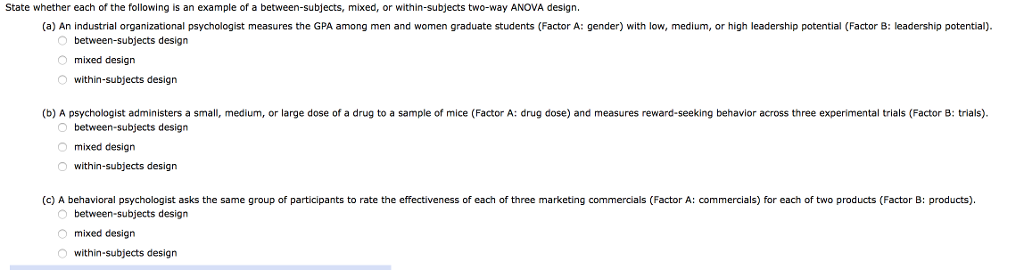
Random assignment is a method for assigning participants in a sample to the different conditions, and it is an important element of all experimental research in psychology and other fields too. Between-subjects design, also known as independent groups design, is a type of experimental design in which different groups of participants are tested under different conditions or at different time points. This means that each participant is only tested under one condition, and the results are compared across the different groups that have been tested. Within-subjects factors involve comparisons of the same subjects under different conditions. A within-subjects factor is sometimes referred to as a repeated-measures factor since repeated measurements are taken on each subject.
Approaches to Dealing with Violations of Sphericity
Have a human editor polish your writing to ensure your arguments are judged on merit, not grammar errors. The probability value is obtained using the \(F\) probability calculator with the new degrees of freedom parameters. The probability of an \(F\) of \(228.06\) or larger with \(1\) and \(45\) degrees of freedom is less than \(0.001\). Therefore, there is no need to worry about the assumption violation in this case.
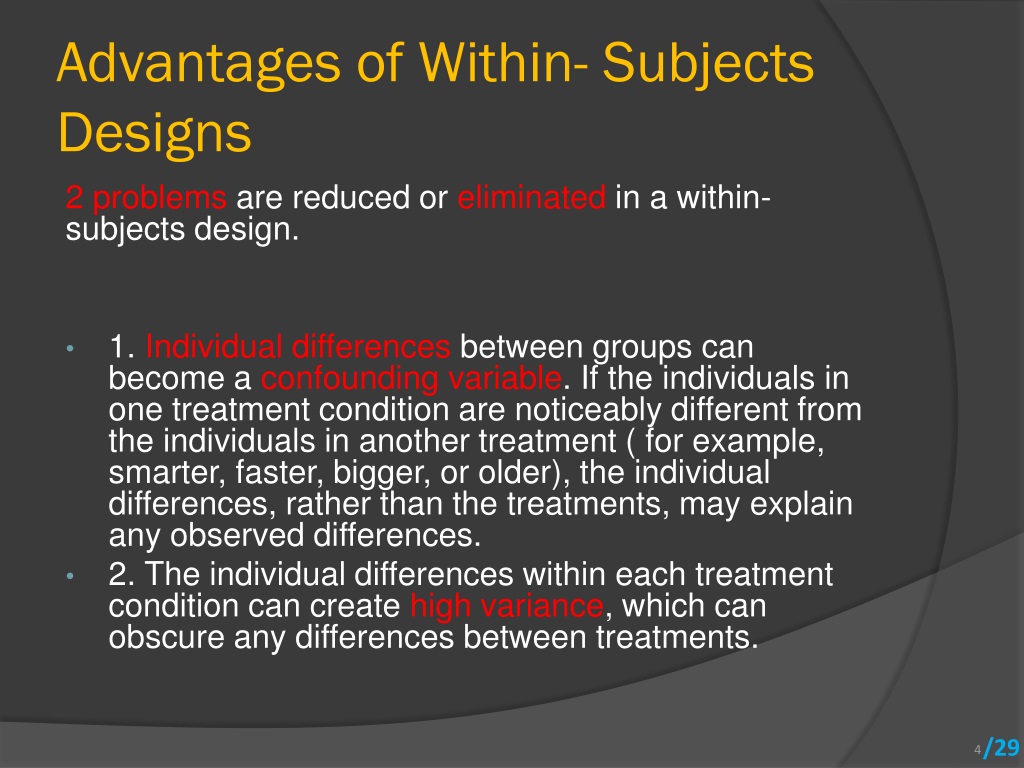
In a within-subjects experiment, each participant is tested under all conditions. In a within-subjects design, the same group of participants is tested under all conditions, so there's no need to worry about potential differences between groups that could confound the results. This makes it easier to control extraneous variables and increases the power of the study, since the same participants serve as their own controls. For example, if you want to test four conditions, using four groups of 30 participants is unwieldy and expensive. Ease is not the only advantage, because a well planned within subject design allows researchers to monitor the effect upon individuals much more easily and lower the possibility of individual differences skewing the results.
It should make intuitive sense that the less consistent the effect of dosage, the larger the dosage effect would have to be in order to be significant. The degree to which the effect of dosage differs depending on the subject is the \(Subjects \times Dosage\)interaction. Recall that an interaction occurs when the effect of one variable differs depending on the level of another variable. In this case, the size of the error term is the extent to which the effect of the variable "Dosage" differs depending on the level of the variable "Subjects." Note that each subject is a different level of the variable "Subjects." If the means for the two dosage levels were equal, the sum of squares would be zero. A between-subjects design would require a large participant pool in order to reach a similar level of statistical significance as a within-subjects design.
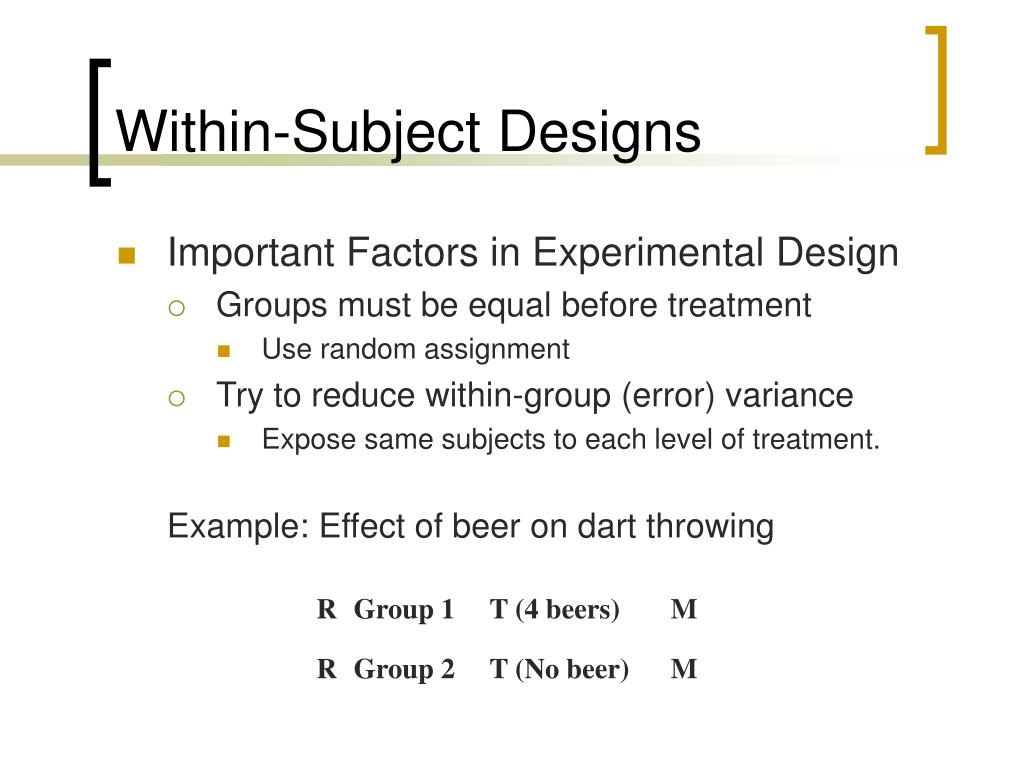
The data comparison occurs within the group of study participants, and each participant serves as their own baseline. In a within-subject design, each participant experiences all experimental conditions, whereas, in a between-subject design, different participants are assigned to each condition, with each experiencing only one condition. This within-subjects design can be compared to what is known as a between-subjects design.
This design controls for individual differences and often requires fewer participants. A within-subjects design, also known as one dependent group, is a research design in which each participant serves as their own control and is exposed to all levels of the independent variable. This means that participants are tested in all study conditions, rather than randomly assigned to only one condition. Within-subjects design, on the other hand, is generally more suitable for studying within-subjects changes or differences, such as the effects of a treatment over time or the difference between two closely related conditions. The primary advantage of this approach is that it provides maximum control of extraneous participant variables.
This design can be used to examine a variety of variables, such as opinions or performance. One disadvantage of this research design is the problem of carryover effects, where the first test adversely influences the other. In a long experiment, with multiple conditions, the participants may be tired and thoroughly fed up of researchers prying and asking questions and pressuring them into taking tests.
This may include paired t-tests, repeated measures ANOVA, or mixed-effects models. Within-subjects design should be used when researchers are interested in studying within-subjects changes or differences, such as the effects of a marketing effort over time or the difference between two closely related screen layouts. The degrees of freedom for the between-subjects variable is equal to the number of levels of the between-subjects variable minus one. Similarly, the degrees of freedom for the within-subjects variable is equal to the number of levels of the variable minus one.
Naturally the assumption of sphericity, like all assumptions, refers to populations not samples. However, it is clear from these sample data that the assumption is not met in the population. There are several actions that could trigger this block including submitting a certain word or phrase, a SQL command or malformed data.
Another common example of a within-subjects design is medical testing, where researchers try to establish whether a drug is effective or whether a placebo effect is in order. The researchers, in the crudest form of the test, will give all of the participants the placebo, for a time, and monitor the results. In within-subjects designs, participants serve as their own control by providing baseline scores across different conditions. All longitudinal studies use within-subjects designs to assess changes within the same individuals over time. Researcher Michael Birnbaum has argued that the lack of context provided by between-subjects designs is often a bigger problem than the context effects created by within-subjects designs.
Within-subjects studies are, thus, more cost-effective than between-subjects ones. In a between-subjects design, different participants take part in each condition, so participant characteristics (e.g., intelligence or memory capacity) often vary between groups. This means it’s hard to say whether the outcomes are truly the result of the independent variable or individual differences between groups. Some longitudinal studies can be experimental when they use a mixed design to study two or more independent variables. If you can directly manipulate one of the independent variables, and participant assignment to conditions, you’re using an experimental approach. Random assignment is not guaranteed to control all extraneous variables across conditions.
Within-subjects designs can also take more time to administer in some cases, so it may be helpful to use a between-sessions design if many participants are available to quickly conduct data collection sessions. Because researchers can’t prevent the effects of time, longitudinal studies usually study correlations between time and other (dependent) variables. In a factorial experiment, the researcher has to decide for each independent variable whether to use a between-subjects design or a within-subjects design. In a within-subjects design, the same participants are tested under all conditions, allowing researchers to control for participant properties. A within-subjects design is a research design in which each participant is exposed to all levels of the independent variable, allowing for a direct comparison of the effects of each level.


No comments:
Post a Comment